
The Power Bill Decides: Hashrate, Tariffs and Daily Net
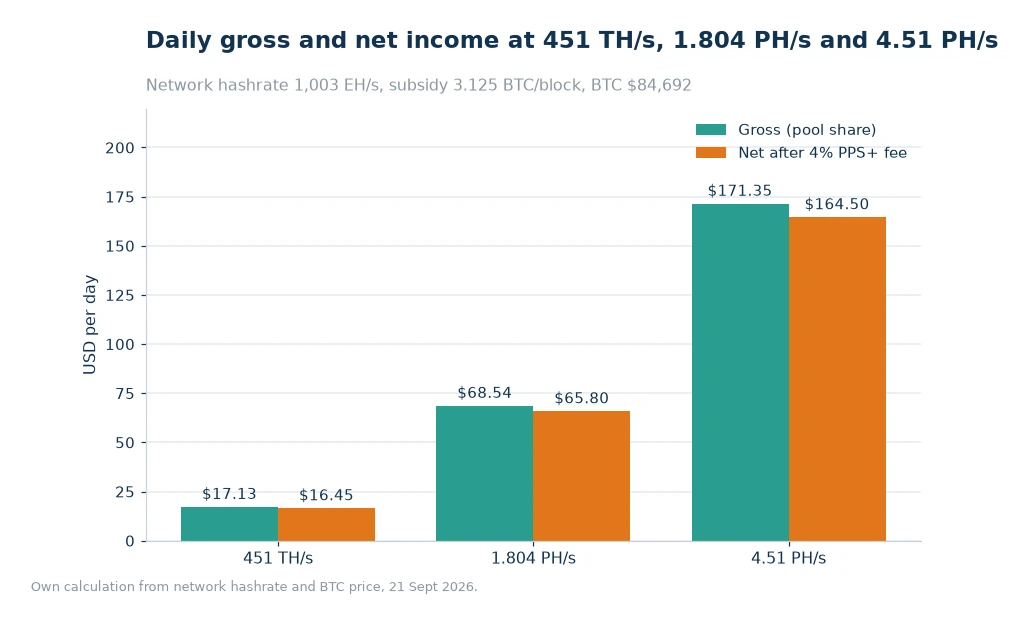
Two operators can run identical machines and get opposite results, because the tariff is as important as the hashrate. At 451 TH/s the pool credits 0.00020232 BTC a day, about $17.13 gross and $16.45 after the listed 4% on the block-reward component. At a moderate power rate a large part of that survives; at a high one it does not.
Key takeaways
- A 451 TH/s rig nets $16.45 a day at BTC $84,692, and every power cost comes out of that figure.
- At 20 J/TH the rig draws about 9.02 kW, or 216.5 kWh a day, so the tariff converts directly into margin.
- A rate of $0.08 per kWh would push that setup slightly below break-even at current difficulty.
- Four units make 1.804 PH/s and ten make 4.51 PH/s, so a site's power cap sets the ceiling before the market does.
Gross hashrate is not the number on the invoice
Hashrate tells you how many shares a machine can produce. It says nothing about what those shares cost to produce, and the gap between the two is where most mining plans fail. The pool credit is the revenue line. Power, cooling, network and maintenance are the cost lines. A machine that looks strong on a specification sheet can be a loss-making appliance once the meter is included.
This is why a site's economics should be built from the bottom up: measured wall draw, actual tariff including demand charges and taxes, and the pool credit at current difficulty. The ViaBTC Mining Pool supplies the revenue side through the account dashboard, while the cost side comes from your own meter and your own bill. Neither half is optional.
A tariff is a second difficulty
Difficulty raises the amount of work needed to earn a coin. A tariff increase does something similar: it raises the cost of the work you already do. The two are not identical, because difficulty is shared by the whole network and a tariff is local, but they hit the same margin line. A site that survives a difficulty rise may not survive a tariff rise, and vice versa.
Operators often track difficulty closely and treat the power contract as a fixed background. That is backwards for a small site, where the tariff is the larger variable and the one that can be negotiated. Read the bill's demand charge and time-of-use bands before assuming the headline rate applies around the clock. A rate that looks cheap at night can be expensive during a peak window when the machines are running flat out.
Sensitivity to a difficulty step
Because difficulty changes the revenue line, it is worth modelling a step rather than a trend. If difficulty rises by 2%, output per unit of hashrate falls by roughly 1.96%, because the same issuance is shared over more work. On a $16.45 net, that is a loss of about $0.32 a day. A 5% rise takes roughly $0.78 a day. Neither is fatal on its own; a sequence of them is.
The estimate at the time of the chain reading pointed the other way, at minus 2.12%, which would add about 2.2% to output if it lands. Treat these numbers as small adjustments to a plan, not as reasons to change course. The larger swings come from the coin price and the tariff, and both deserve more attention than a single difficulty forecast.
Where the listed fee sits in the stack
PPS+ charges a listed 4% on the block-reward component and a listed 2% on the transaction-fee component. Those two rates apply to different parts of the reward, so they cannot be added into a single number. For planning, the practical effect is that the block-reward portion arrives at 96% of its gross value while the fee portion is settled under a separate arrangement.
The distinction matters when comparing pools, because a headline rate can hide which component it touches. It also matters when a site is close to break-even: a tenth of a percent on the block-reward portion is a real amount over a year. The fee schedule is the document to read before comparing offers, not a summary from a forum.
Hourly settlement and the cash-flow gap
PPS+ pays the block-reward component hourly against current difficulty. For a site with a monthly power bill, that is a useful rhythm: credits arrive every day, and the bill arrives once. The gap between the two is a working-capital question, not a profitability question, but it can still hurt if a repair or a deposit lands in the same week as a large invoice.
A simple buffer of a few days of power cost covers most surprises. Keep it in the same currency you pay the bill in, and top it up from the mining credits rather than from a separate account. A site that runs its power bill from the mining wallet can see exactly how much of the credit is consumed by operations and how much is genuinely surplus.
Choosing a shutdown point in advance
The most useful number a site can write down is its shutdown price: the tariff, difficulty or coin price at which a machine should be switched off rather than run at a loss. Decide it while the machines are profitable, because the decision is harder to make in the middle of a bad month. For a 451 TH/s unit at 20 J/TH, the break-even tariff at current difficulty is roughly $0.0759 per kWh before any maintenance allowance.
Write the figure on the wall of the control room and check it at each tariff renewal. If the contract moves above it, the machines come off until the numbers change. That is not a prediction about the market; it is a rule about the site, and it protects the operator from funding a loss out of habit.
The table runs three tariffs through the same machine, using 20 J/TH as the efficiency input. The margin column is what remains after power, before maintenance and cooling.
| Tariff per kWh | Daily power cost | Net pool income | Margin before cooling |
|---|---|---|---|
| $0.04 | $8.66 | $16.45 | $7.79 |
| $0.06 | $12.99 | $16.45 | $3.46 |
| $0.08 | $17.32 | $16.45 | -$0.87 |
Worked example
Take the 451 TH/s machine and carry it from hashrate to the tariff table.
- Daily BTC: 451 × 0.00000044861 = 0.00020232 BTC.
- Gross USD: 0.00020232 × 84,692 = $17.13.
- Listed 4% on the block-reward component: $17.13 × 0.04 = $0.69, leaving $16.45 net.
- Power draw at 20 J/TH: 451 × 20 = 9,020 W, or 9.02 kW.
- Daily energy: 9.02 kW × 24 hours = 216.48 kWh.
- At $0.06 per kWh: 216.48 × 0.06 = $12.99 a day.
- Margin: $16.45 − $12.99 = $3.46 a day, or about $104 a month before cooling and repairs.
- Break-even tariff: $16.45 ÷ 216.48 = $0.0759 per kWh.
Frequently asked questions
What tariff makes mining unprofitable?
There is no universal figure because efficiency and difficulty vary, but for a 451 TH/s unit at 20 J/TH the break-even rate is about $0.0759 per kWh before cooling and maintenance.
Does the listed fee change with the power rate?
No. The listed 4% applies to the block-reward component and the listed 2% to the transaction-fee component regardless of your tariff; power is a separate cost that comes out after the pool credit.
Should I include cooling in the break-even?
Yes. Cooling is part of the energy a site consumes, and leaving it out makes the break-even tariff look better than it is, especially in a warm climate where air conditioning runs alongside the miners.
Set the break-even before the bill arrives
Write the shutdown tariff, the current net and the power draw on one page, then update it at each renewal and each difficulty adjustment. If the page says the site is above break-even, run it and bank the difference. If it says otherwise, stop before the loss compounds. The Profit Calculator is a quick way to re-run the revenue side when the inputs change.
Sources: ViaBTC pricing, calculator and pool pages for the component split and the calculator method. Chain inputs read 21 Sept 2026: network hashrate 1,003 EH/s, difficulty 132.76 T, subsidy 3.125 BTC, 144 blocks a day, BTC price $84,692. Published 24 Oct 2026; 20 J/TH is an illustrative efficiency figure rather than a claim about any model[1].