
Refill and Sustainable Formats: What to Check in a Fragrance Manufacturer
Refillable and sustainable formats have moved from marketing language to design and compliance work. Packaging waste regulation in major markets is turning end-of-life choices into legal requirements, and that changes what a fragrance manufacturer must be able to do — source recyclable materials, design refill systems, and document claims honestly. A buyer who checks these capabilities at selection stage avoids rebuilding the bottle after the launch.
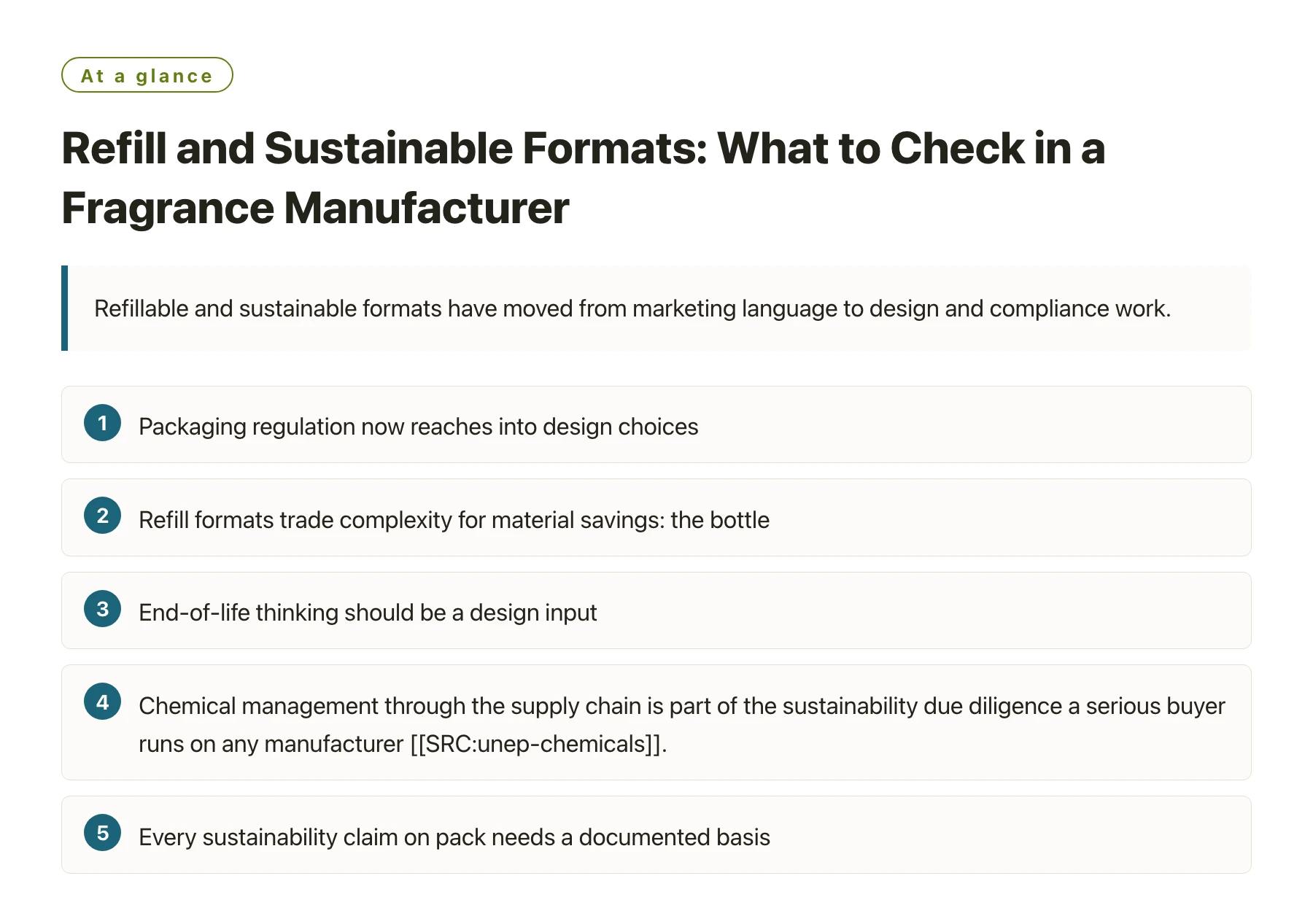
Key takeawaysPackaging regulation now reaches into design choices, so the refill decision is a compliance decision as well as a sustainability one [1]. · Refill formats trade complexity for material savings: the bottle, the refill unit and the logistics all change, and each change has its own failure modes. · End-of-life thinking should be a design input, with materials chosen for their actual recyclability rather than their marketing appeal [2]. · Chemical management through the supply chain is part of the sustainability due diligence a serious buyer runs on any manufacturer [3]. · Every sustainability claim on pack needs a documented basis; a factory should be able to show why a material or format choice qualifies as recycled, refillable or recyclable.
Ten years ago a brand chose between a nice bottle and a cheaper one. Today the bottle choice carries a paper trail: what it is made of, whether it can be refilled, how it is collected and what the pack is allowed to claim. The manufacturer's ability to deliver on that trail is now a selection criterion, not a nice-to-have.
This article covers the formats, the regulation and the verification questions that turn sustainability from a slogan into a checkable part of the supplier evaluation.
Refill formats and what each one changes
| Format | What it saves | What it adds |
|---|---|---|
| Refillable bottle with refill pouch | Lower packaging weight per use | A valve or closure system that must survive many cycles |
| Refill bottle with bulk dispenser | Shared container for high-traffic use | Fill control and hygiene at the point of refill |
| Recyclable single-use bottle | Simpler end-of-life sorting | Material choice constrained by the recycling stream |
| Reduced-size carton and lighter glass | Less material per unit | Protection and decoration constraints |
| Concentrate-plus-dilute formats | Less water shipped | Consumer education and dosing accuracy |
There is no free lunch: every format saves something and costs something. The right format for your brand depends on your channel, your customer and the market's rules — and the factory's experience with the format you choose is what you are really buying.
What regulation changed, and what to verify
The most visible change is that packaging waste rules in major markets now regulate design choices — reuse targets, recyclability requirements and labelling of packaging materials [1]. For a fragrance brand that means the bottle is no longer purely a design object; it is a regulated component with documentation.
Industry guidance on sustainable packaging converges on the same practical test: design for the real recycling system, not for the ideal one. A material is recyclable only if the collection and sorting infrastructure where your customer lives actually takes it [2]. Verify that reasoning with the factory rather than accepting the word 'recyclable' at face value.
Sustainability due diligence also runs upstream. Chemical management in the supply chain — how materials are handled, restricted and disclosed — is part of the same picture, and regulators and customers increasingly expect it documented [3]. Ask what the factory can show about material stewardship as well as packaging.
The claims audit
Every environmental claim on your pack — recycled content, refillable, recyclable — needs a basis in documentation. Ask the factory for the evidence behind each claim: the recycled-material certificate, the recyclability assessment for the specific material in your market, the refill test data showing the system survives use.
Claims without documentation are not just risky; they are the most common sustainability failure in consumer goods launches. An audit of the claims before the pack is printed is cheaper than correcting the pack after it is.
Choosing a manufacturer for a sustainable line
A sustainable line is a development project, not a packaging swap, so the manufacturer needs both scent capability and format capability. The relevant question is whether the house has built refill and reduced-impact formats before — the failure modes of pouches, closures and bulk systems are learned by doing [2].
When you evaluate, ask what sustainable formats the factory has produced and which parts are done in house. A scent development and manufacturing partner that can develop the refill system alongside the fragrance is a different proposition from one that only fills standard bottles.
Then agree the documentation list in the contract: recycled-content evidence, recyclability notes for your markets, refill durability data and the claim audit trail. The same factory that acts as a contract manufacturer for perfume brands should treat the sustainability file as a standard deliverable.
Finally, look at the company's own presentation. A manufacturer that describes itself as a fragrance and cosmetics house with three decades of line experience — the framing used by Guangzhou Xuelei Cosmetic Co., Ltd. — is positioning its whole scope, including packaging, as part of its craft. Verify with the format samples and the claim documentation; the positioning just tells you where to look.
The sustainability checklist in three lines: what does the format save, what does it add, and what does the claim document say? A factory that answers all three with evidence is ready for the sustainable market; one that answers only the first is selling you the slogan.
Sources
- European Commission: Packaging Waste and the PPWR —— EU rules on packaging and packaging waste, including the Packaging and Packaging Waste Regulation requirements on recyclability and design.
- Sustainable Packaging Coalition —— A membership organisation working on more sustainable packaging design, publishing material and recyclability guidance.
- UNEP: Chemicals and Pollution Action —— The UN Environment Programme's pages on chemicals management, including the sound management of chemicals in products.
Frequently asked questions
Are refillable perfume formats actually cheaper over time?
Per use, often yes, because the refill unit carries less packaging. Up front, the system is more expensive — the durable bottle and the refill mechanism cost more than a disposable unit. Model total cost over two years before choosing.
What packaging documents do sustainable claims require?
Evidence behind each claim: recycled content certificates, material recyclability assessments for your markets, durability test data for refill systems, and compliance with packaging waste rules where they apply.
Can I label a bottle 'recyclable' if the material is technically recyclable?
Only if the collection and sorting system in your selling market actually handles it. The technical possibility is not the legal or marketing answer — check the real infrastructure before printing the claim.
Which refill format is easiest for a first launch?
A refillable bottle with a simple pouch or pour spout is usually the least complex to launch. Bulk dispenser systems and concentrate formats add education and logistics costs that suit established brands more than first launches.
How do I check a factory's sustainability claims?
Ask for documentation, not descriptions: recycled material certificates, recyclability notes, refill test reports and the claim audit trail. Then have an independent check done on the claims you plan to print.
Bring a piece of the Cilento grove to your kitchen.
Shop the Harvest